
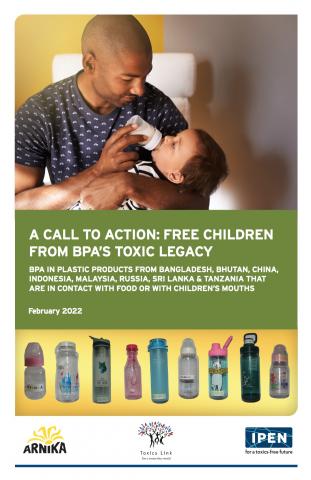
This report studied BPA in products in Bangladesh, Bhutan, China, Indonesia, Malaysia, Russia, Sri Lanka & Tanzania that come into contact with food or with children’s mouths.
From the introduction:
Bisphenol A (BPA) is a synthetic chemical used in a wide range of products such as epoxy paints and glue, lining of food cans, and thermal paper receipts. BPA is also used as a building block in polycarbonate plastics which can be used to make food containers and baby bottles, despite BPA being a known endocrine disrupting chemical (EDC). Several million metric tonnes of BPA are produced yearly, even though BPA is associated with several negative effects on the environment and human health.
BPA and its metabolites have been found in urine, blood, saliva, umbilical cord, placenta and amniotic fluid and samples collected from people around the world indicate that more than 90% of the world’s population have BPA in their bodies. New-born and infant exposure to BPA increases the sensitivity of hormone-sensitive organs to later-life exposures to estrogens or chemical carcinogens.
Moreover, BPA levels found in children are typically higher than in adults. This is due to the higher food consumption per body weight in early life and dust ingestion associated with hand-to-mouth contact behaviour in children, as well as a higher use of plastic products. Babies are exposed to BPA when it leaches from bottles and other containers into beverages and food they consume.

 English
  简体中文
简体中文  Français
  Bahasa Indonesia
  Русский
  Español
  العربية
  Shqip
Shqip  Հայերեն
  Azərbaycan dili
  Беларуская мова
  Български
  Cantonese
  Hrvatski
  Čeština
  ქართული
  Deutsch
  Ελληνικά
  हिन्दी
  Қазақ тілі
  한국어
한국어  Кыргызча
  Bahasa Melayu
  नेपाली
  Português do Brasil
  Kiswahili
  Svenska
  Tagalog
  தமிழ்
தமிழ்  ไทย
ไทย  Українська
  Tiếng Việt