

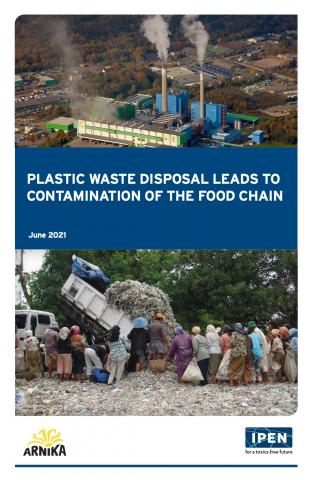
Waste generated from the use of plastics is a challenge for the whole of human society. Plastics are everywhere around us, and we can find tiny parts of plastics in even the most pristine places. Most plastics were invented by chemical scientists, and in order to make the plastic suitable for many different uses or to make them meet legislative requirements for fire safety, for example, they need chemical additives that make the plastic resistant, flexible, durable or less flammable. Many of these additives have not only been found to be toxic in themselves, but also lead to the creation of new chemicals, like brominated and chlorinated dioxins, when burned. These new chemicals can be even more toxic than the original additives.
The focus of this study has been on very toxic persistent organic pollutants (POPs) entering the food chain at locations where plastic waste is being recycled, burned, incinerated or dumped. Samples of free-range chicken eggs were analyzed for brominated and chlorinated dioxins (PBDD/Fs and PCDD/Fs), dioxin-like PCBs (dl-PCBs), BFRs, SCCPs, and PFASs. Free-range chicken eggs are sensitive indicators of POP contamination in soils/dust and represent an important human exposure pathway. As “active samplers” they can be used to reveal POPs contamination, particularly in areas impacted by dioxins (PCDD/Fs) and PCBs as well as by BFRs. Thirty-five pooled and one individual free-range eggs from twenty-five different locations worldwide were analyzed for selected POPs in accredited laboratories.

 English
  简体中文
简体中文  Français
  Bahasa Indonesia
  Русский
  Español
  العربية
  Shqip
Shqip  Հայերեն
  Azərbaycan dili
  Беларуская мова
  Български
  Cantonese
  Hrvatski
  Čeština
  ქართული
  Deutsch
  Ελληνικά
  हिन्दी
  Қазақ тілі
  한국어
한국어  Кыргызча
  Bahasa Melayu
  नेपाली
  Português do Brasil
  Kiswahili
  Svenska
  Tagalog
  தமிழ்
தமிழ்  ไทย
ไทย  Українська
  Tiếng Việt