

Weak regulations mean losing control of dioxin contamination
The widely used current limit value for POPs in waste (Low POPs Content Levels) leaves vast amounts of industrial wastes containing dioxins out of control. With this weak limit level there is no requirement to destroy or irreversibly transform dioxin content in those wastes and it is not even necessary to register reuse of such waste as construction material or backfill in remediation projects. This is how dioxins in wastes can get spread without control and contribute to overall contamination of environment.
It was estimated recently that the amount of PCDD/Fs in waste incinerator fly ash, which is virtually without control in the environment, is approximately 7.5 kg TEQ/year and can accumulate in the food chain over time. While this may not seem a large volume, PCDD/DFs are toxic in the part per billion range. So this yearly amount would be sufficient to exceed the tolerable weekly intake (WHO-TWI) of 14 pg TEQ/kg body weight for the entire human population by 19 times, or if considering the recently updated European Food Safety Authority (EFSA) TWI, 7.5 kg TEQ/year of dioxin is sufficient to exceed the TWI of the population of this planet by 133 times (Petrlik, Kuepouo et al. 2021).
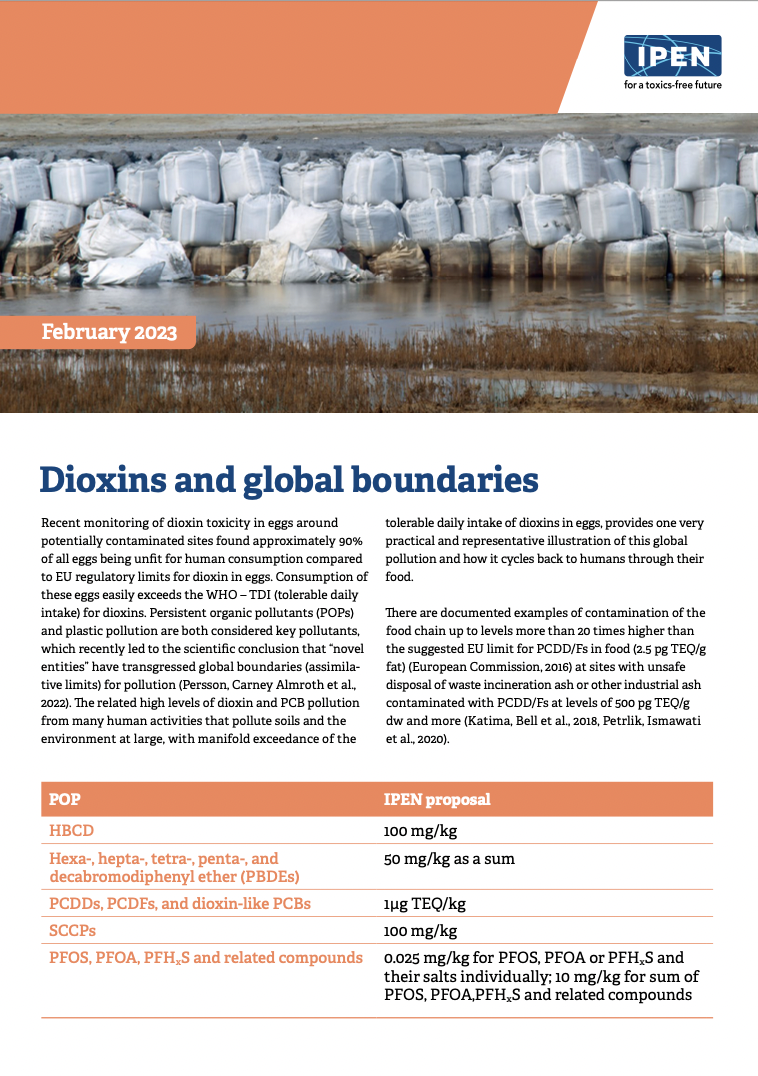
Read the fact sheet below for details

 English
  简体中文
简体中文  Français
  Bahasa Indonesia
  Русский
  Español
  العربية
  Shqip
Shqip  Հայերեն
  Azərbaycan dili
  Беларуская мова
  Български
  Cantonese
  Hrvatski
  Čeština
  ქართული
  Deutsch
  Ελληνικά
  हिन्दी
  Қазақ тілі
  한국어
한국어  Кыргызча
  Bahasa Melayu
  नेपाली
  Português do Brasil
  Kiswahili
  Svenska
  Tagalog
  தமிழ்
தமிழ்  ไทย
ไทย  Українська
  Tiếng Việt