

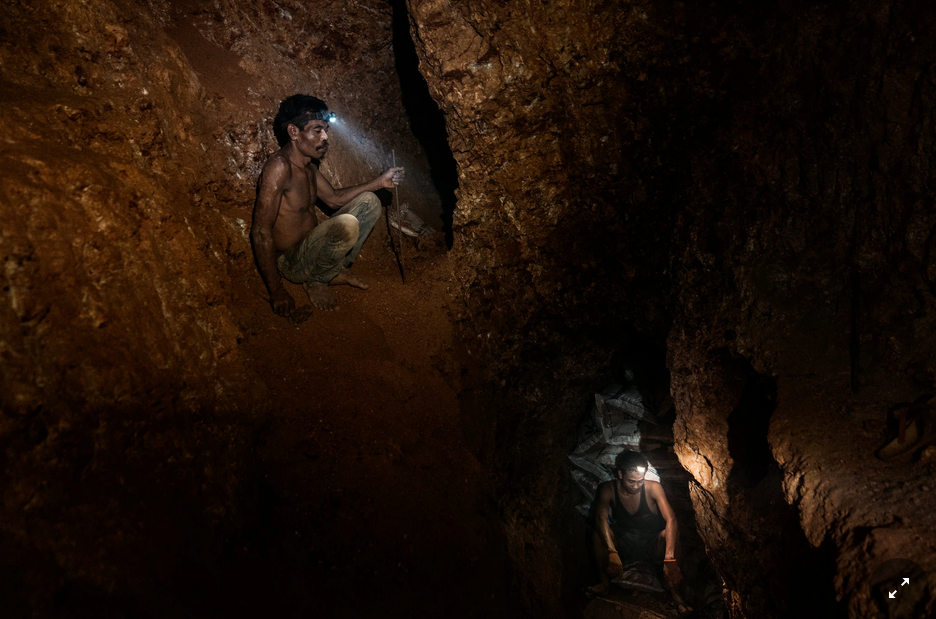
New York Times – Hidden Cost of Gold
CIDAHU, Indonesia — Thousands of children with crippling birth defects. Half a million people poisoned. A toxic chemical found in the food supply. Accusations of a government cover-up and police officers on the take.
This is the legacy of Indonesia’s mercury trade, a business intertwined with the lucrative and illegal production of gold.
More than a hundred nations have joined a global campaign to reduce the international trade in mercury, an element so toxic there is “no known safe level of exposure,” according to health experts.
But that effort has backfired in Indonesia, where illicit backyard manufacturers have sprung up to supply wildcat miners and replace mercury that was previously imported from abroad. Now, Indonesia produces so much black-market mercury that it has become a major global supplier, surreptitiously shipping thousands of tons to other parts of the world.
Much of the mercury is destined for use in gold mining in Africa and Asia, passing through hubs such as Dubai and Singapore, according to court records — and the trade has deadly consequences.
“It is a public health crisis,” said Yuyun Ismawati, a co-founder of an Indonesian environmental group, Nexus3 Foundation, and a recipient of the 2009 Goldman Environmental Prize. She has called for a worldwide ban on using mercury in gold mining.
Mercury can be highly dangerous as it accumulates up the food chain, causing a wide range of disorders, including birth defects, neurological problems and even death.
Today, despite the risks, small-scale miners using mercury operate in about 80 countries in Asia, Africa and the Americas. They produce up to 25 percent of all gold sold.
As gold makes its way around the world, so too does mercury — poisoning the air and food of people thousands of miles away. Small-scale gold mining is the largest single source of mercury pollution.
A recent IPEN study of women on 24 remote islands found that more than half displayed high mercury levels. The women lived far from sources of mercury pollution but ate a diet rich in fish. In the United States, contaminated fish is the No. 1 source of mercury poisoning.
Ms. Yuyun, the environmentalist, estimates that illicit manufacturers in Indonesia produce more than 10,000 tons of mercury a year. About a third is used in gold mining in Indonesia, she said, the rest smuggled overseas.
The government banned the use of mercury in gold mining in 2014, but has done little to curb its use, clean up contaminated sites or warn the public of the danger.
In surveys of 24 hot spots, the Nexus3 Foundation and a team of independent doctors found more than 700 cases of suspected mercury poisoning, including children with birth defects and villagers with irreversible neurological disorders. At least 45 have died.
Based on these studies, the environmental group estimates that decades of mining have poisoned 500,000 people.
“It’s a crime to deliberately conceal the damning results,” said Ms. Yuyun, the lead researcher on small-scale mining at the International Pollutants Elimination Network. “People are dying and have little access to any effective treatment. The government has to stop the mercury trade and clean up the mess.”
Environment Ministry officials declined to be interviewed and did not respond to written questions.
Read the full story.
 English
  简体中文
简体中文  Français
  Bahasa Indonesia
  Русский
  Español
  العربية
  Shqip
Shqip  Հայերեն
  Azərbaycan dili
  Беларуская мова
  Български
  Cantonese
  Hrvatski
  Čeština
  ქართული
  Deutsch
  Ελληνικά
  हिन्दी
  Қазақ тілі
  한국어
한국어  Кыргызча
  Bahasa Melayu
  नेपाली
  Português do Brasil
  Kiswahili
  Svenska
  Tagalog
  தமிழ்
தமிழ்  ไทย
ไทย  Українська
  Tiếng Việt