

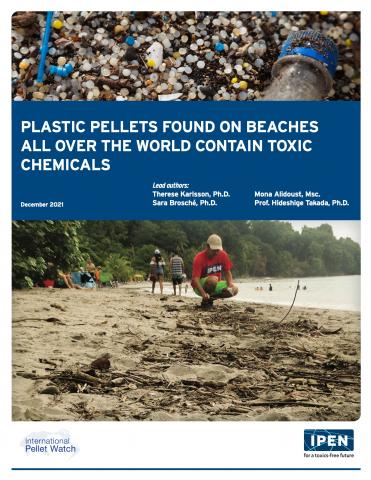
Preproduction plastics in the size of lentils, known as plastic pellets, or nurdles, are used to make plastic products but are often lost during production, transportation, and storage. These pellets have been found on beaches all over the world since the 1970s. They can carry many different chemicals, both those that have been purposely added to the plastics and pollutants that attach (sorb) to the plastics in the environment. Some of these chemicals are especially concerning since they are known to have several negative effects on human health and the environment.
In this study, plastic pellets from 23 different countries were analyzed for thirteen different types of polychlorinated biphenyls (PCBs) and ten benzotriazole UV stabilizers (BUVs). PCBs have been banned since the mid-1990s as part of the dirty dozen but are still frequently found in the environment. BUVs are frequently added to plastic products, but are known to leach out and to have endocrine-disrupting effects. All sampled PCBs and BUVs, including UV-328, were found in samples from all locations in the study. The concentrations were especially high in the samples from African countries, which illustrates how African countries often bear a heavy burden of plastic pollution, even though they are not major producers of neither chemicals nor plastics.
The results from this study clearly show that beached plastics are not only bringing the physical pollution of plastic littering, but also chemical pollutants in the form of added and sorbed chemicals. Furthermore, it illustrates that plastics can play a very important role in the long-range transport of toxic chemicals.

 English
  简体中文
简体中文  Français
  Bahasa Indonesia
  Русский
  Español
  العربية
  Shqip
Shqip  Հայերեն
  Azərbaycan dili
  Беларуская мова
  Български
  Cantonese
  Hrvatski
  Čeština
  ქართული
  Deutsch
  Ελληνικά
  हिन्दी
  Қазақ тілі
  한국어
한국어  Кыргызча
  Bahasa Melayu
  नेपाली
  Português do Brasil
  Kiswahili
  Svenska
  Tagalog
  தமிழ்
தமிழ்  ไทย
ไทย  Українська
  Tiếng Việt