
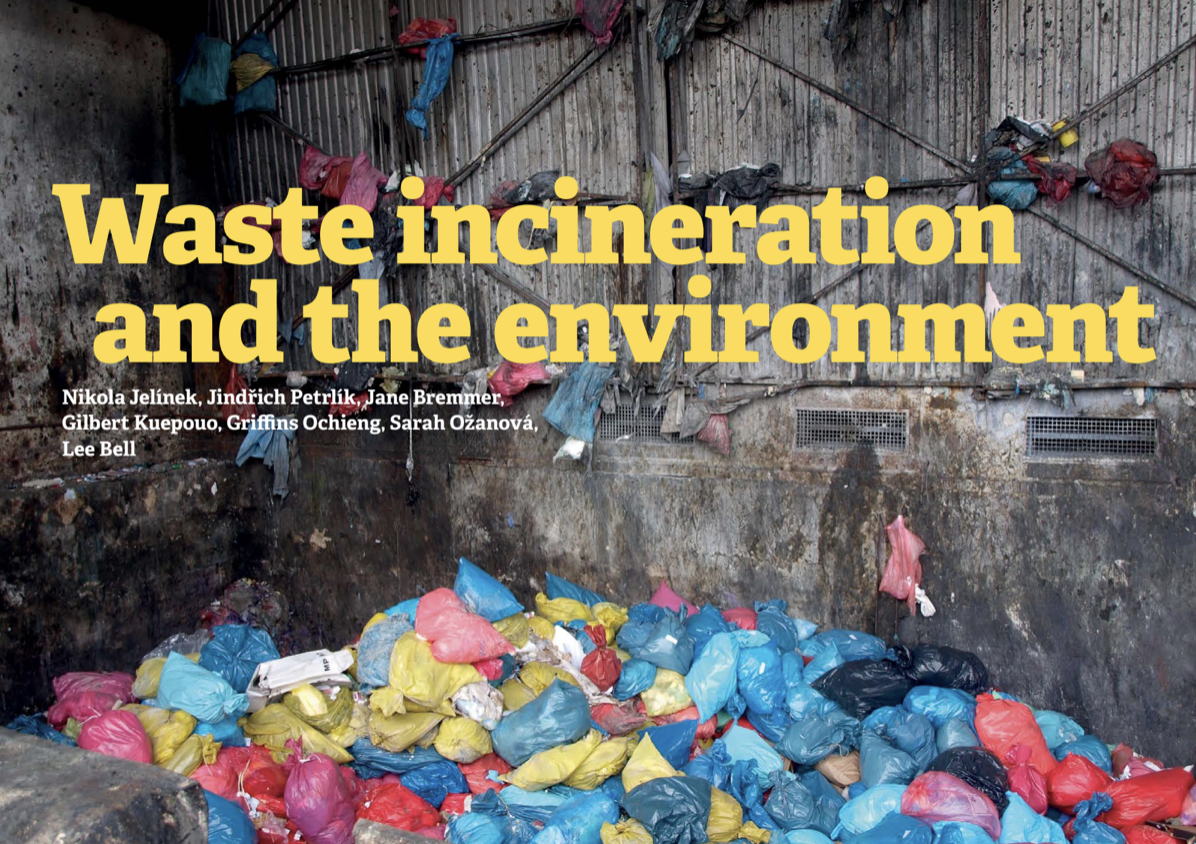
A comprehensive new report “Waste incineration and the Environment” released today by Arnika, the Centre for Environment Justice and Development (CEJAD) in Kenya, Centre de Recherche et d‘Education pour le Développement (CREPD) in Cameroon, Toxics Free Australia (TFA), and IPEN finds that burning waste, especially plastics, produces unsustainable and unmanageable hazardous air emissions and large amounts of highly toxic solid residues (ash), concluding that alternatives to incineration should be implemented globally.
KEY FINDINGS
- Waste incineration is not a solution to the triple planetary crisis – it actually contributes to it. Incinerating waste emits large volumes of CO2, pollutes the environment with a variety of toxic chemicals including dioxins, mercury, and many others in quantities exceeding planetary limits, and contributes to biodiversity loss.
- Waste incineration destroys valuable phosphorus resources in biowaste and disrupts global biogeochemical cycles.
- Communities living near incinerators may be at higher risk of health issues due to their harmful effects.
- Air emissions are not the only pollution pathway from waste incinerators: Both fly ash and bottom ash from incinerators are highly contaminated with dioxins and other chemicals such as PFAS.
- Emissions to air from waste incinerators are not fully controlled, as some very toxic substances are monitored for only a few hours twice a year or not measured at all.
- Waste incinerators cannot operate without state subsidies and other forms of economic support from public budgets.
- Alternatives to waste incineration exist for most waste streams, with examples included in the report.
See the press release here.
Download the full report and summary, below.

 English
  简体中文
简体中文  Français
  Bahasa Indonesia
  Русский
  Español
  العربية
  Shqip
Shqip  Հայերեն
  Azərbaycan dili
  Беларуская мова
  Български
  Cantonese
  Hrvatski
  Čeština
  ქართული
  Deutsch
  Ελληνικά
  हिन्दी
  Қазақ тілі
  한국어
한국어  Кыргызча
  Bahasa Melayu
  नेपाली
  Português do Brasil
  Kiswahili
  Svenska
  Tagalog
  தமிழ்
தமிழ்  ไทย
ไทย  Українська
  Tiếng Việt