

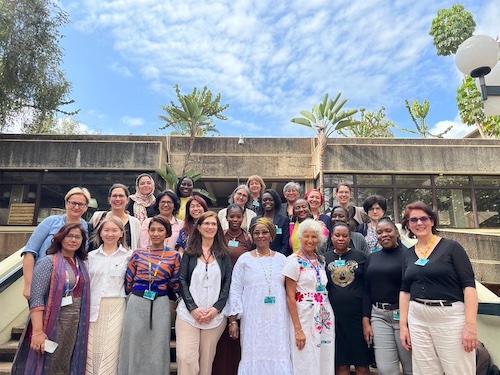
By Tripti Arora, IPEN Gender Coordinator
Ana Paula Souza is a Human Rights Officer at the Office of the United Nations High Commissioner
Ana Paula Souza’s engagement with chemicals and pollution took on new urgency in 2022 when she joined the environment and climate change team at the UN. Tasked with working on pollution at a time when the Plastics Treaty negotiations were just beginning, she quickly realised how deeply chemicals shape everyday life, often invisibly, and often unjustly. As she became more aware of how toxic exposure intersects with gender, inequality, and human rights, the issue stopped being technical and became personal. That shift strengthened her commitment to advancing justice in chemicals governance, particularly for women and marginalised communities.
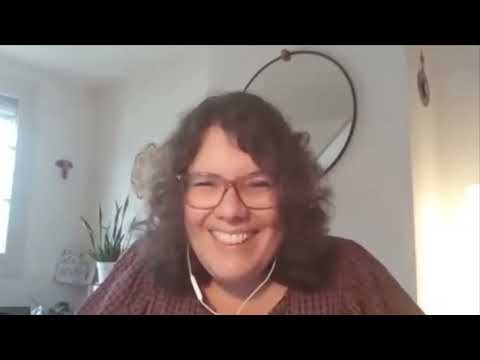
Speaking about what motivates her, she noted,
“What inspires me and what motivates me is justice. The issue of chemicals and how that has an impact on gender is a matter of justice. I am a lawyer by training. Even when I was in law school in Brazil, I was working on different projects with communities, bringing more notions of human rights, democracy, and constitutional rights to communities in the suburbs, in favelas, or trade unions. I believe in power to the people. I believe that we are not just victims. Even those who are not in positions of power can do something.”
Her work over the years has taken her into some of the most difficult areas of human rights.
“I worked with people who had been tortured, arbitrarily detained, evicted, and victims of contemporary forms of slavery, trafficking, servitude, and sale of organs. I worked with child soldiers. That has always motivated me.
When I joined the UN, I worked on the Voluntary Fund on Contemporary Forms of Slavery. Reviewing grant proposals brought me very close to the stories of survivors. I remember a woman from Nepal who was drugged, woke up in India without a kidney, chained, and forced into sex work. When she was asked what she wanted in life, she said, ‘I want education. I want to rebuild my life.’
That resilience stays with me. It is the most beautiful thing when it is unleashed.”
In 2022, her focus shifted.
“I moved to the environment and climate change team. I thought I would be working on climate change. My supervisor said, ‘We need to work on multiple planetary crises. We don’t have any programme on pollution. Can you work on that? And by the way, negotiations on plastics start tomorrow.’
I accepted the challenge. I never imagined I would find such passion working on chemicals.
When you start being aware, it becomes personal. I became angry, angry for being unaware, for being manipulated. Chemicals are everywhere. I look around and see plastics and wonder what I could have done differently. That awareness changes you.”
She reflected on one of the major challenges she sees in this space.
“There is a disconnect between environmental organizations and human rights organizations. Environmental actors sometimes say human rights will compromise negotiations. Human rights actors say chemicals are too technical.
But if chemicals impact the environment we live in and our health, then it is a human issue. And if it is a human issue, it is a human rights issue.”
On the specific challenges women face, she emphasized the need for better data.
“We need more data, especially in areas where there are information gaps. There are black spots where we simply do not have visibility.
We need more gender-disaggregated data. Without it, we cannot see the full impact.
Exposure is not only physiological. It is shaped by social structures, by the roles women play in agriculture, caregiving, and informal work. If we do not see that structure, we miss the point.”
She also shared a moment from her earlier work that continues to stay with her.
“When I worked on Indigenous Peoples’ rights, we organized an event at the UN bringing Indigenous women with disabilities. No one was talking about Indigenous Peoples with disabilities at that time.
After that meeting, they created a caucus within the Indigenous Peoples’ movement. Years later, one of the original participants told me she had met a transgender Indigenous woman with disabilities who also needed visibility.
That is meaningful to me, opening spaces for voices that feel invisible.”
On the evolving relationship between gender equality and chemicals governance, she acknowledged both progress and resistance.
“There is a gender backlash. We have seen it in negotiations, language being questioned, divides becoming clearer.
At the same time, we are seeing those who were not outspoken before now defending gender equality. We already agreed to these commitments. They are part of the SDGs and international frameworks.
We must not reduce gender to just men and women. Gender is about social constructs and structural inequalities. If we do that, we miss the point.”
When discussing strategies for advancing policy, she was clear:
“Science is very important. We need robust, independent science.
Most research has been centred on the Global North and certain populations. There are large information gaps regarding underrepresented groups and the Global South.
We do not know what we do not know.
But science alone is not enough. Human rights bridge science and policy. When you attach ‘right to health’ or ‘right to a healthy environment,’ you create obligation. You identify duty bearers and rights holders.
We must also protect science from corporate interference and ensure it remains independent.”
She described international human rights mechanisms as practical tools.
“Environmental governance often has no teeth. Human rights systems have baby teeth, but at least they have teeth.
Mechanisms like treaty bodies and the Universal Periodic Review allow states to be examined. Civil society can submit information. That evidence can shape recommendations.
Many environmental organizations are not fully using these human rights mechanisms. They should. They are tools. All these instruments are part of the same toolbox.”
On collaboration, her message was simple.
“We need bigger alliances. Resources are shrinking. We need to multiply, not divide.
Civil society generates evidence and brings lived experience. Governments implement. International organizations can support and provide normative guidance.
Connection and solidarity are essential.”
Her advice to emerging professionals was practical.
“Do not be intimidated by technical language. You do not need to pronounce every chemical name.
Learn how the systems work. Many human rights mechanisms are accessible. You can submit reports. You can engage.
Be persistent. Change takes time.”
Looking ahead, she spoke about what keeps her motivated.
“I hope to see more data, more visibility of black spots, stronger enforcement of policies, and more corporate accountability.
We also need to engage investors. The market is a force. If investors see risk, change can happen.
What keeps me motivated is that we are finding entry points. We are building bridges. It is not easy, but it is possible.”
Ana’s reflections put the issue of gender and chemicals in perspective. They reiterate the need to bring science, policy, and action together to ensure women’s safety, strengthen chemical safety, and advance environmental governance in a meaningful way. They also highlight that without visibility, accountability, and sustained implementation, commitments remain on paper. Ultimately, advancing chemical safety must be rooted in justice, ensuring that those most affected are recognized, heard, and protected.
 English
  简体中文
简体中文  Français
  Bahasa Indonesia
  Русский
  Español
  العربية
  Shqip
Shqip  Հայերեն
  Azərbaycan dili
  Беларуская мова
  Български
  Cantonese
  Hrvatski
  Čeština
  ქართული
  Deutsch
  Ελληνικά
  हिन्दी
  Қазақ тілі
  한국어
한국어  Кыргызча
  Bahasa Melayu
  नेपाली
  Português do Brasil
  Kiswahili
  Svenska
  Tagalog
  தமிழ்
தமிழ்  ไทย
ไทย  Українська
  Tiếng Việt