

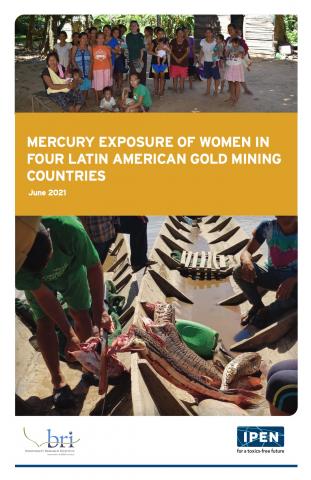
This study of mercury levels in women from four Latin American communities is the latest compilation of data in IPEN’s global mercury biomonitoring program. Hair samples were taken from women living in or near the mining towns of Vila Nova, Brazil, El Callao, Venezuela, Íquira, Colombia, and two groups living in Bolvia’s Beni river system. The results for the Bolivian women were especially concerning: they had the highest mercury levels in our study, yet have no engagement with mining or contact with mercury and are reliant on a subsistence fish diet. This suggests that many more women who have a fish rich diet in this region are at risk of high levels of mercury exposure through their diet.
NGOs used identical methods to collect hair samples at the four locations. Biodiversity Research Institute (BRI) in the USA performed the analyses of samples, reporting mercury concentrations in parts per million (ppm) for comparison against the USEPA threshold level of 1 ppm. The methodology, analysis and comparison to reference levels are described in chapter 2.
The levels of mercury in Esse Ejja women on the Beni River equaled or exceeded the highest levels detected in any previous IPEN studies. The lowest levels in this study were found in Íquira, a town in the Huila Province, Colombia, where no women surveyed ate fish and mercury was phased out of gold mining several years ago.

 English
  简体中文
简体中文  Français
  Bahasa Indonesia
  Русский
  Español
  العربية
  Shqip
Shqip  Հայերեն
  Azərbaycan dili
  Беларуская мова
  Български
  Cantonese
  Hrvatski
  Čeština
  ქართული
  Deutsch
  Ελληνικά
  हिन्दी
  Қазақ тілі
  한국어
한국어  Кыргызча
  Bahasa Melayu
  नेपाली
  Português do Brasil
  Kiswahili
  Svenska
  Tagalog
  தமிழ்
தமிழ்  ไทย
ไทย  Українська
  Tiếng Việt