

Recent research on uv-328 further proves its potential to undergo long-range transport, bioaccumulate, and cause harm
Background from this document:
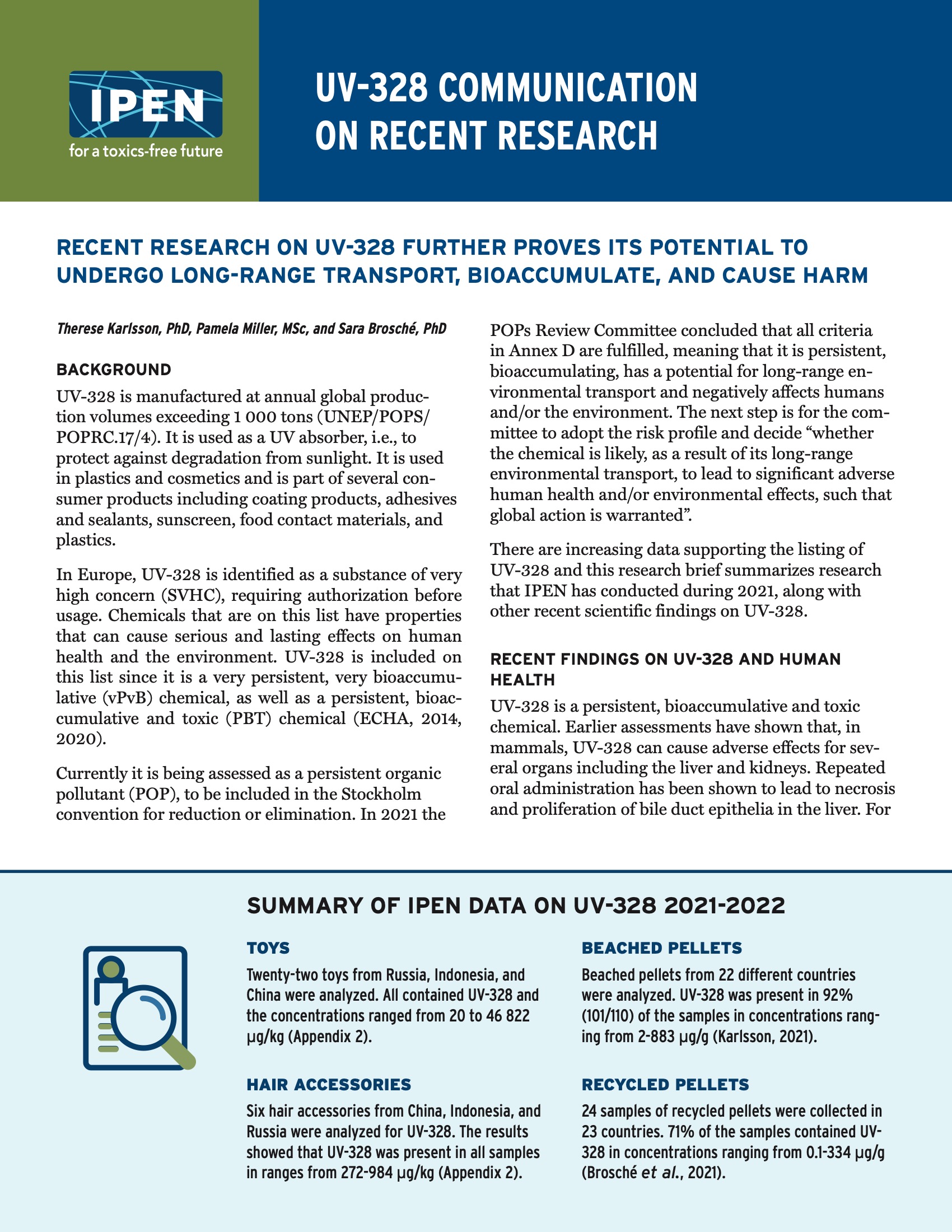
UV-328 is manufactured at annual global production volumes exceeding 1 000 tons (UNEP/POPS/ POPRC.17/4). It is used as a UV absorber, i.e., to protect against degradation from sunlight. It is used in plastics and cosmetics and is part of several consumer products including coating products, adhesives and sealants, sunscreen, food contact materials, and plastics.
In Europe, UV-328 is identified as a substance of very high concern (SVHC), requiring authorization before usage. Chemicals that are on this list have properties that can cause serious and lasting effects on human health and the environment. UV-328 is included on this list since it is a very persistent, very bioaccumulative (vPvB) chemical, as well as a persistent, bioaccumulative and toxic (PBT) chemical (ECHA, 2014, 2020).
Currently it is being assessed as a persistent organic pollutant (POP), to be included in the Stockholm convention for reduction or elimination. In 2021 the POPs Review Committee concluded that all criteria in Annex D are fulfilled, meaning that it is persistent, bioaccumulating, has a potential for long-range environmental transport and negatively affects humans and/or the environment. The next step is for the committee to adopt the risk profile and decide “whether the chemical is likely, as a result of its long-range environmental transport, to lead to significant adverse human health and/or environmental effects, such that global action is warranted”.
There are increasing data supporting the listing of UV-328 and this research brief summarizes research that IPEN has conducted during 2021, along with other recent scientific findings on UV-328.
Read the full document below.

 English
  简体中文
简体中文  Français
  Bahasa Indonesia
  Русский
  Español
  العربية
  Shqip
Shqip  Հայերեն
  Azərbaycan dili
  Беларуская мова
  Български
  Cantonese
  Hrvatski
  Čeština
  ქართული
  Deutsch
  Ελληνικά
  हिन्दी
  Қазақ тілі
  한국어
한국어  Кыргызча
  Bahasa Melayu
  नेपाली
  Português do Brasil
  Kiswahili
  Svenska
  Tagalog
  தமிழ்
தமிழ்  ไทย
ไทย  Українська
  Tiếng Việt