

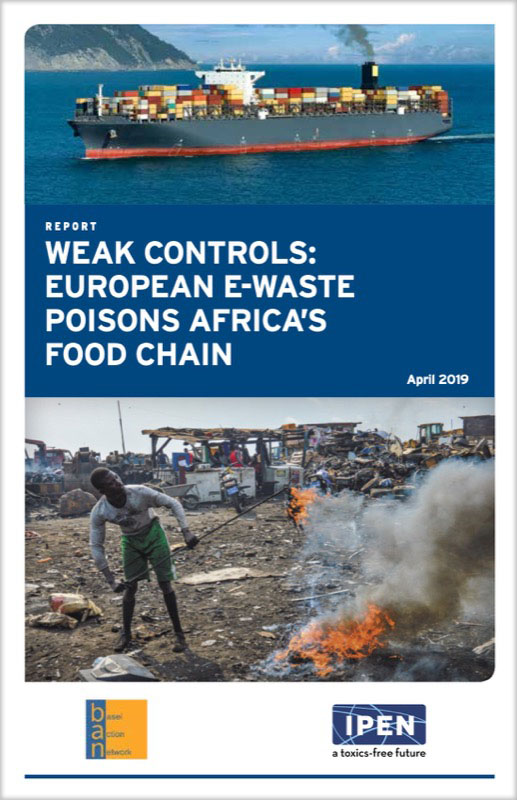
New studies by IPEN and the Basel Action Network (BAN) reveal how weak controls in international treaties allow developed countries to export e-waste to developing countries, leading to dangerous levels of POPs exposure, and resulting in food chain contamination. The key findings of this report are:
- Alarmingly high levels of some of the most hazardous chemicals on earth, including dioxins, brominated dioxins, PCBs, PBDE, and SCCPs in the eggs of chickens that had foraged in areas where electronic waste was burned to recover metal.
- The highest-ever measured level of brominated dioxins in egg samples were discovered at Agbogbloshie.
- The analysis exposed the second highest level of dioxins ever measured in eggs, found at the Agbogbloshie scrap yard in Ghana.
- The source of the POPs at Agbogbloshie is burning plastic associated with e-wastes and auto scrap to recover metals.
- At this site, level of indicator PCB congeners exceeds the EU safe limits for egg consumption by 4-times and the safe limits for dioxins and dioxin-like PCB by 171-times.
- The samples also contained very high levels of short chained chlorinated paraffins (SCCPs), a recently listed POP for which the EU is proposing the weakest ever regulatory limits (Low POPs Content levels) in the history of the Stockholm Convention.
- Brominated flame-retardant levels were also very high in egg samples from Agbogbloshie. The analysis revealed very high levels of PBDEs and one of the highest-ever measured levels of HBCD, comparable to the highest level of HBCD ever measured in Germany.
- The totality of findings are very worrying, as they add to already published results of high levels of POPs measured in soil, sediments, water or human tissues from Agbogbloshie in previous studies. The findings demonstrate food chain contamination and human exposure to high levels of POPs as a consequence of poor controls on the international e-waste trade.

 English
  简体中文
简体中文  Français
  Bahasa Indonesia
  Русский
  Español
  العربية
  Shqip
Shqip  Հայերեն
  Azərbaycan dili
  Беларуская мова
  Български
  Cantonese
  Hrvatski
  Čeština
  ქართული
  Deutsch
  Ελληνικά
  हिन्दी
  Қазақ тілі
  한국어
한국어  Кыргызча
  Bahasa Melayu
  नेपाली
  Português do Brasil
  Kiswahili
  Svenska
  Tagalog
  தமிழ்
தமிழ்  ไทย
ไทย  Українська
  Tiếng Việt