
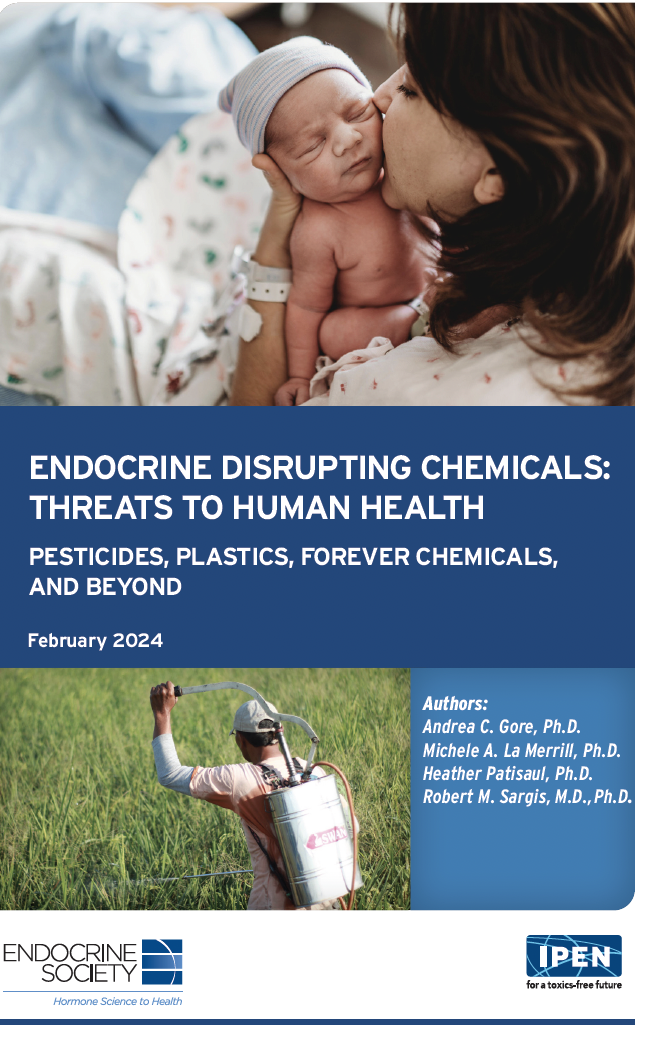
The report “Endocrine Disrupting Chemicals: Threats to Human Health” by the Endocrine Society in collaboration with IPEN provides a comprehensive update on the state of the science around EDCs, with increasing evidence that this large group of toxic substances may be implicated in rising global health concerns. Evidence detailed in the report suggests that EDCs in the environment can contribute to disorders such as diabetes, neurological disorders, reproductive disorders, inflammation, and compromised immune functioning.
Four detailed analyses of exposures to EDCs are included in the report:
- 农药: The report reviews three highly hazardous pesticides, including glyphosate, the world’s most widely used herbicide. A recent study found that glyphosate has eight of ten key characteristics of an EDC, and other studies have found links between glyphosate and adverse reproductive health outcomes.
- 塑料: Plastics are made with thousands of known toxic substances, some of which are known or suspected EDCs. Exposures to EDCs from plastics occur at all phases of plastics production, use, disposal, and even from recycled plastics.
- Consumer products (including children’s products): Lead and arsenic are EDCs that have been detected in numerous consumer products. Endocrine-related conditions from lead exposure may include delayed onset of puberty and early menopause. Arsenic has been linked to cancer and other health conditions, and more recent evidence shows that arsenic can disrupt multiple endocrine systems.
- Per-and polyfluoroalkyl substances (PFAS): PFAS are a class of thousands of chemicals that are known or suspected to be EDCs. Recent studies show that some PFAS can disrupt hormones such as estrogen and testosterone and impair thyroid hormone functions.
Read the press release.

 English
  简体中文
简体中文  Français
  Bahasa Indonesia
  Русский
  Español
  العربية
  Shqip
Shqip  Հայերեն
  Azərbaycan dili
  Беларуская мова
  Български
  Cantonese
  Hrvatski
  Čeština
  ქართული
  Deutsch
  Ελληνικά
  हिन्दी
  Қазақ тілі
  한국어
한국어  Кыргызча
  Bahasa Melayu
  नेपाली
  Português do Brasil
  Kiswahili
  Svenska
  Tagalog
  தமிழ்
தமிழ்  ไทย
ไทย  Українська
  Tiếng Việt