
What is a circular economy?
A circular economy aims at changing the economic take-make-waste approach to one that minimizes extraction of natural resources and waste creation. It is seen as key to sustainability, including in the UN 2030 Agenda for Sustainable Development (SDG 12). The European Union Circular Economy Action Plan also aims to design for sustainability, encouraging products that last longer, are easier to use, recycle and repair, that incorporate more recycled materials, that limit single-use, and that maximize an item’s lifespan.
A circular economy for plastics?
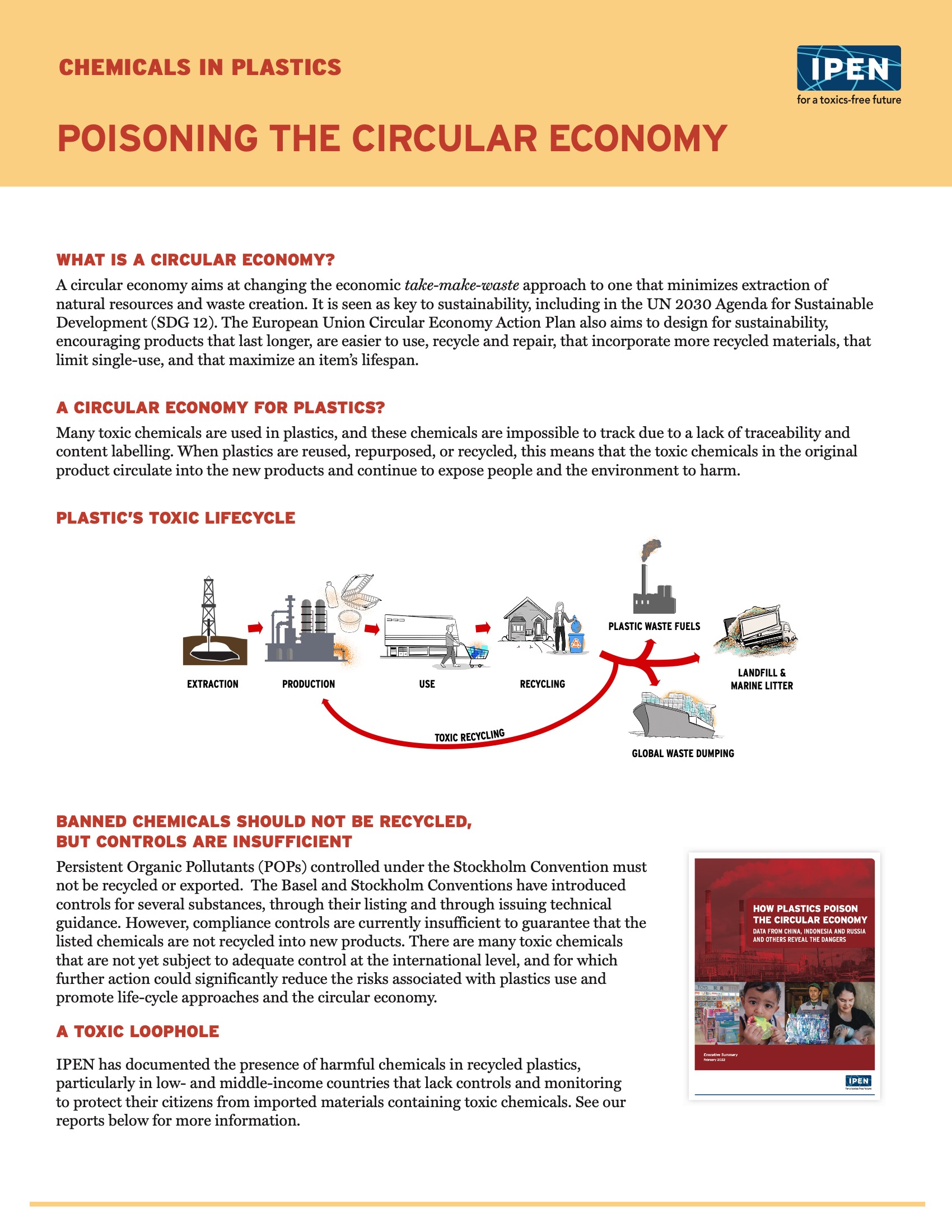
Many toxic chemicals are used in plastics, and these chemicals are impossible to track due to a lack of traceability and content labelling. When plastics are reused, repurposed, or recycled, this means that the toxic chemicals in the original product circulate into the new products and continue to expose people and the environment to harm.
Plastic’s toxic lifecycle

Banned chemicals should not be recycled, but controls are insufficient
Persistent Organic Pollutants (POPs) controlled under the Stockholm Convention must not be recycled or exported. The Basel and Stockholm Conventions have introduced controls for several substances, through their listing and through issuing technical guidance. However, compliance controls are currently insufficient to guarantee that the listed chemicals are not recycled into new products. There are many toxic chemicals that are not yet subject to adequate control at the international level, and for which further action could significantly reduce the risks associated with plastics use and promote life-cycle approaches and the circular economy.
A toxic loophole
IPEN has documented the presence of harmful chemicals in recycled plastics, particularly in low- and middle-income countries that lack controls and monitoring to protect their citizens from imported materials containing toxic chemicals. See our reports below for more information.
Read More about a Plastics Treaty

 English
  简体中文
简体中文  Français
  Bahasa Indonesia
  Русский
  Español
  العربية
  Shqip
Shqip  Հայերեն
  Azərbaycan dili
  Беларуская мова
  Български
  Cantonese
  Hrvatski
  Čeština
  ქართული
  Deutsch
  Ελληνικά
  हिन्दी
  Қазақ тілі
  한국어
한국어  Кыргызча
  Bahasa Melayu
  नेपाली
  Português do Brasil
  Kiswahili
  Svenska
  Tagalog
  தமிழ்
தமிழ்  ไทย
ไทย  Українська
  Tiếng Việt