

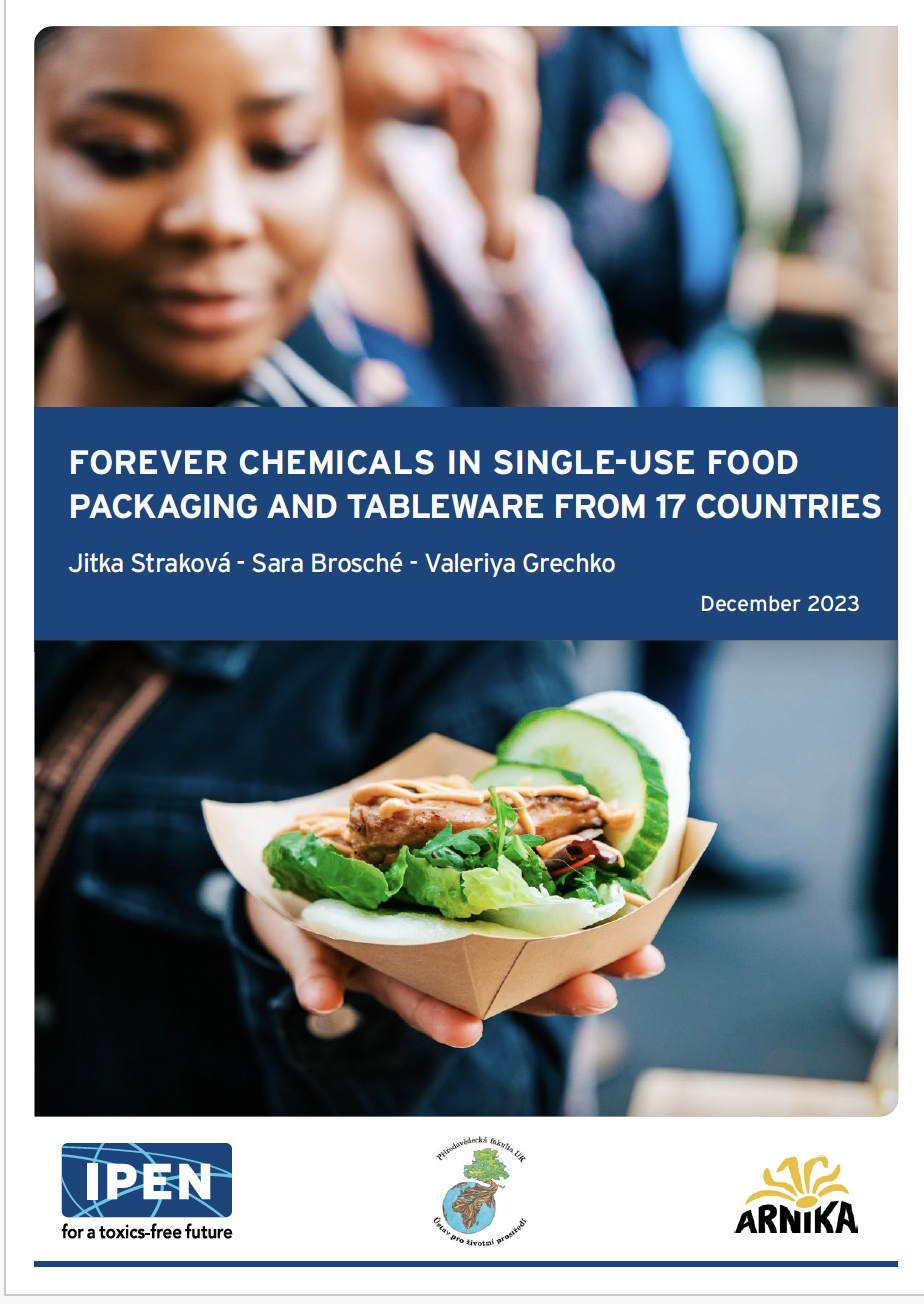
PFAS (per- and polyfluoroalkyl substances) are a large group of chemicals used ubiquitously in consumer and professional products, despite concerns around their health and environmental impacts. Due to their grease-resistance properties, PFAS are widely used in fast-food and take-away containers, microwave popcorn bags, and compostable tableware.
This study was conducted to assess PFAS use and unintentional contamination in paper, cardboard, and plant- based food packaging and tableware from 17 countries across Asia, Africa, Europe, Latin America and the Caribbean, and to contribute to the achievement of the universal ban of all PFAS internationally.
One hundred nineteen samples of food packaging were tested. The results showed that 64 of the samples (54%) contained PFAS, including fast-food packaging from major fast food chains.
PFAS are known to migrate from food packaging into food and consumption of food that was packed in PFAS-treated paper is associated with PFAS levels in human blood. The popularity of fast-food consumption, especially among youth, raises concerns regarding the contribution of food packaging to PFAS exposure during crucial times of development.
Viable alternatives to PFAS-treated paper and cardboard food contact materials exist and are already in use. Several samples from every tested product category in this study contained no PFAS.
Setting legislative thresholds for a few small groups of PFAS is not sufficient to control these harmful substances in food packaging. Only a universal ban, including polymeric PFAS, can stop human exposure and release from food packaging.
Therefore, the most efficient control measure for reducing the release of PFAS into the environment and for avoiding hazardous (so-called “regrettable”) PFAS substitutes is to have a complete global ban by the Stockholm Convention and national governments.

 English
  简体中文
简体中文  Français
  Bahasa Indonesia
  Русский
  Español
  العربية
  Shqip
Shqip  Հայերեն
  Azərbaycan dili
  Беларуская мова
  Български
  Cantonese
  Hrvatski
  Čeština
  ქართული
  Deutsch
  Ελληνικά
  हिन्दी
  Қазақ тілі
  한국어
한국어  Кыргызча
  Bahasa Melayu
  नेपाली
  Português do Brasil
  Kiswahili
  Svenska
  Tagalog
  தமிழ்
தமிழ்  ไทย
ไทย  Українська
  Tiếng Việt