
IPEN’s Role: Ending Exposures to POPs
From its inception, IPEN has contributed original science, research, and policy solutions to inform and enhance the development of the Stockholm Convention on Persistent Organic Pollutants (POPs).
The Convention entered into force in 2004 with ratification by an initial group of 128 nations. Today, more than 200 countries are Parties to the Convention and meet biannually at the Conference of Parties (COP). More than 40 POPs, including some chemical groups that cover hundreds of chemicals, are listed for global elimination under the Convention.
See information on IPEN’s recent work on the BRS Conventions and other work on POPs.
IPEN was founded in 1998 in response to negotiations toward a global treaty to control POPs – an agreement that would come to be called the Stockholm Convention. At the time, dozens of organizations from mostly low- and middle-income countries in Africa, Asia, Latin America, and elsewhere were coming together to participate in the POPs treaty talks. Unlike larger, global environmental groups who saw a treaty as an end goal, these groups understood that for their communities, the real work to address toxic pollution would only just be starting once a treaty was adopted. Facing serious health hazards from POPs and other hazardous chemicals, these groups not only wanted a meaningful treaty but also knew that they would need to remain vigilant for implementation of a treaty in ways that would help protect their communities.
During Treaty negotiations in Montreal in 1998, these organizations came together for the first time as IPEN. They developed a common platform calling for a POPs treaty that would eliminate, and not merely manage, these highly toxic substances.
In 2001, IPEN released its Stockholm Declaration on POPs at the Diplomatic Conference where countries signed the Stockholm Convention. The declaration heralded the Stockholm Convention as “The first negotiated, global, legally binding instrument that will oblige governments to take actions aimed at eliminating these pollutants from the world’s environment.”
At the inception of the Stockholm Convention, twelve chemicals were designated for the Convention’s list of POPs slated for global elimination (known as “the dirty dozen” POPs). Included were toxic pesticides like DDT, hazardous industrial chemicals like PCBs, chemicals released by industrial production and waste burning like dioxins, and other hazardous substances (read the 2001 Stockholm Convention text here). Today, more than 40 POPs, including some chemical groups that cover hundreds of chemicals, are listed for global elimination under the Convention.
In 2003, IPEN was granted a Special Recognition Award by the Intergovernmental Forum on Chemical Safety for exemplary work during the Stockholm Convention negotiations. As the Convention entered into force, from 2004-2007, IPEN worked to implement its objectives through an International POPs Elimination Project (IPEP) in a collaboration with the Global Environmental Facility, United Nations Industrial Development Organization (UNIDO), and the United Nations Environment Programme (UNEP), to provide low- and middle-income countries with research and policy support for identifying and managing POPs impacts in their countries. The IPEP work led to IPEN’s development of eight regional Hubs and created the model of global-to-local action that serves as IPEN’s theory of change to this day. Though funding originally aimed to support projects in 40 countries, IPEN far exceeded this goal, with nearly 300 projects conducted by more than 350 IPEN member groups in 65 countries.
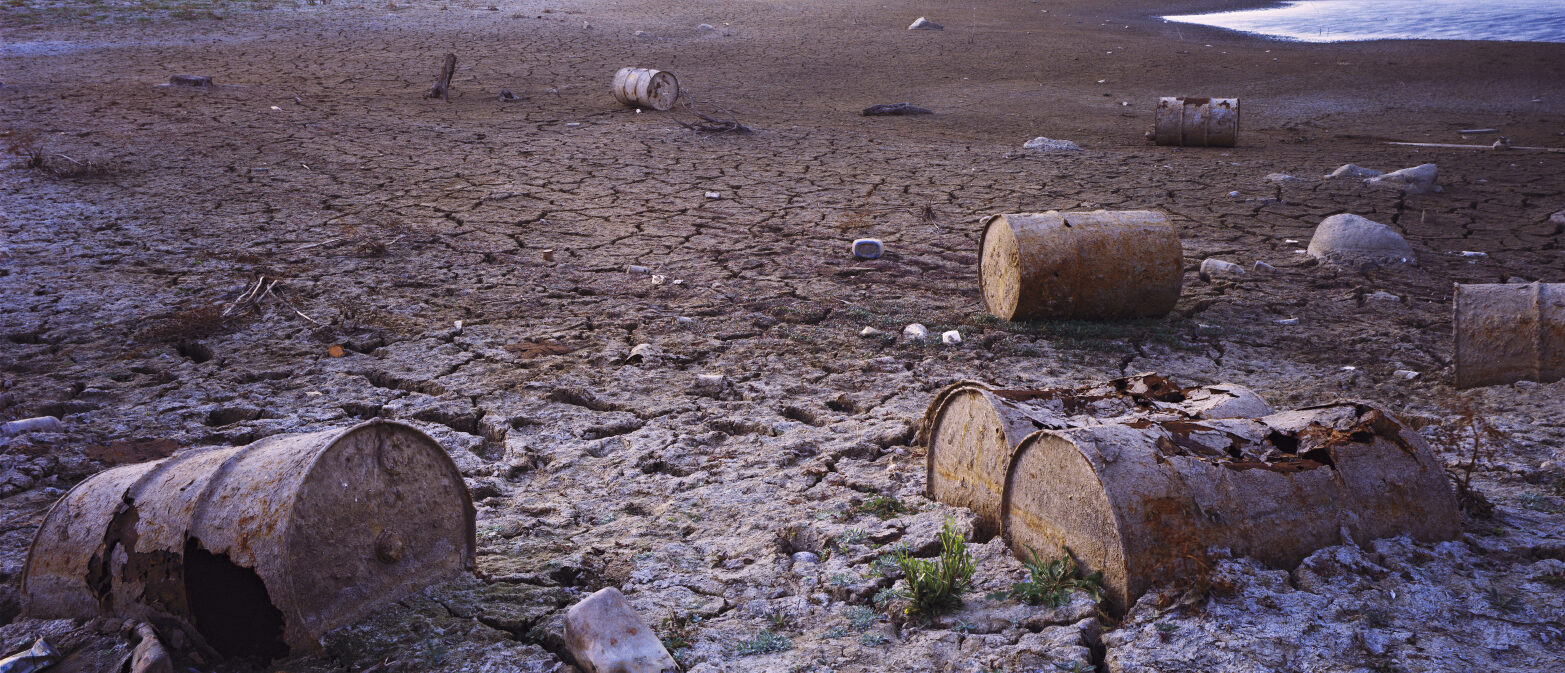
IPEN has engaged in every Stockholm Convention COP and related Convention meetings since its founding, contributing original scientific research and policy recommendations. IPEN co-authored the globally accepted guidelines adopted by the Stockholm Convention for cleaning up and managing sites contaminated by POPs and has developed global maps to show examples of some contaminated sites, demonstrating the breadth of the problem. IPEN members have produced research reports on issues around POPs pollution in their nations, on POPs and food chain contamination, and on progress in eliminating PCBs, among other POPs-related concerns.
IPEN also provides data, research, and policy proposals at the meetings of the Convention’s advisory body, the POPs Review Committee (POPRC). At POPRC meetings, IPEN’s contributions have informed the deliberations and fostered development of science-based recommendations for protecting public health and the environment from many hazardous chemicals. Some highlights include
- Working with firefighters and emergency response professionals, IPEN co-hosted an educational event on PFAS Contamination at POPRC 15. The Committee recommended that PFHXs, a PFAS chemical used in firefighting foams, should be subject to a global ban. Previously, IPEN’s report on PFAS-chemicals in firefighting foams helped educate the Committee on the need for a ban.
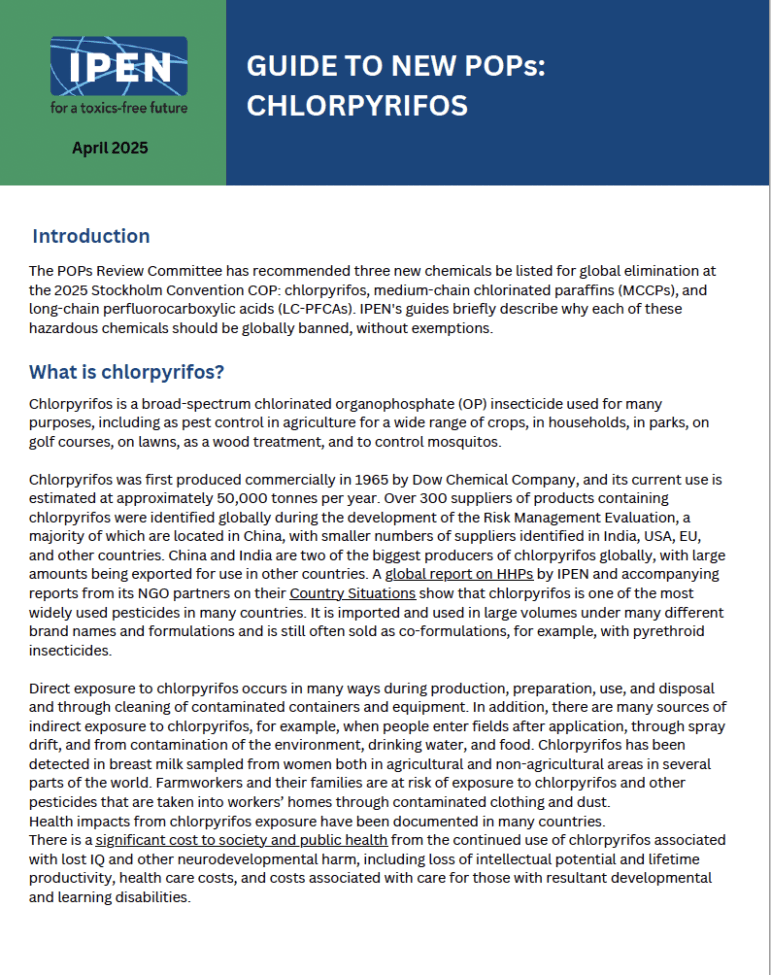
- In 2017, IPEN released a Guide to New POPs, recommending global bans on three hazardous chemicals.
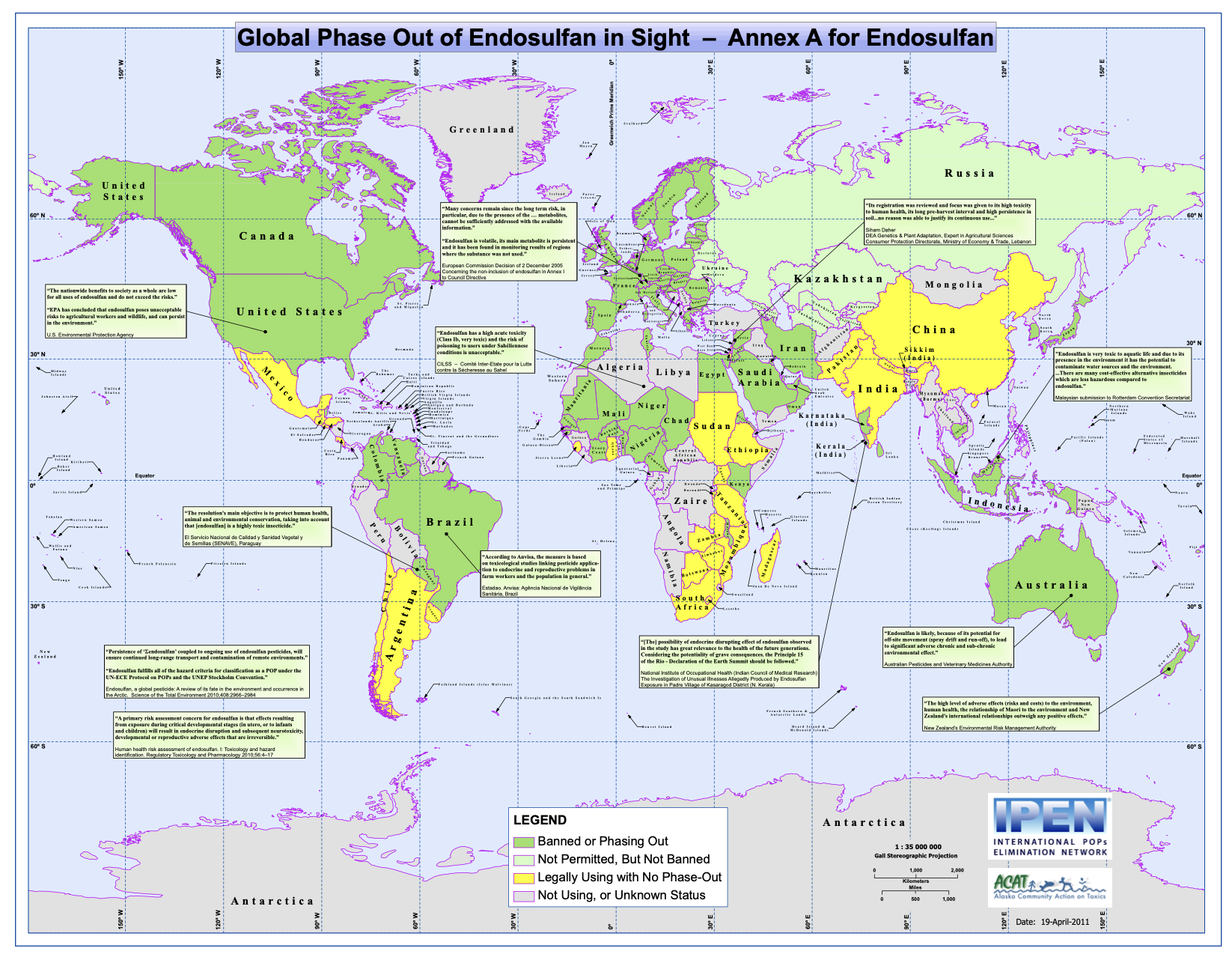
- In earlier meetings, IPEN successfully advocated for a recommendation for a global ban on the toxic pesticide endosulfan. IPEN member Alaska Community Action on Toxics created a global endosulfan map to highlight the worldwide threats from the pesticide.
See information on IPEN’s work on the BRS Conventions and other work on POPs.