
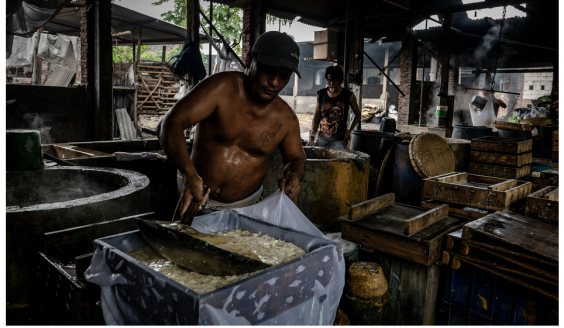
Reporting from Tropodo, Indonesia, the New York Times notes that more than 30 commercial kitchens in Tropodo, a village on the eastern side of Indonesia’s main island, Java, fuel their tofu production by burning a mix of paper and plastic waste, some of it shipped from the United States after Americans dumped it in their recycling bins.
The backyard kitchens produce much of the area’s tofu, an inexpensive and high-protein food made from soy that is an important part of the local diet. But the smoke and ash produced by the burning plastic has far-reaching and toxic consequences.
Testing of eggs laid by chickens in Tropodo, a village of 5,000 people, found high levels of several hazardous chemicals including dioxin — a pollutant known to cause cancer, birth defects and Parkinson’s disease — according to a report released this week by an alliance of Indonesian and international environmental groups.
The dioxin found in Tropodo is the end product in a chain of malfeasance, carelessness and governmental neglect.
An egg laid by one of Mr. Karnawi’s chickens had one of the highest levels of dioxin ever recorded in Asia, the report found.
The levels of dioxin found in that egg were second only to eggs collected near Bien Hoa, Vietnam, the former United States air base that was a Vietnam War staging area for the defoliant Agent Orange, which contains dioxin. The United States recently began a 10-year, $390 million cleanup at Bien Hoa, which remains heavily contaminated nearly five decades after the war ended.
An adult who eats just one egg like the one taken from Mr. Karnawi’s henhouse would exceed the United States daily safety threshold by nearly 25-fold and the stricter European Food Safety Authority standard by 70-fold.
Eggs are commonly used for testing contamination because chickens effectively sample the soil as they forage and toxins accumulate in their eggs.
“These stark findings illustrate the dangers of plastics for human health and should move policymakers to ban plastic waste combustion, address environmental contamination, and rigorously control imports,” said Lee Bell, an adviser to the International Pollutants Elimination Network and a co-author of the report.
The study was conducted by four environmental groups: Ecoton and the Nexus3 Foundation, based in Indonesia; Arnika, based in Prague; and the International Pollutants Elimination Network or IPEN, a global network dedicated to eliminating toxic pollutants.
“This is plastic collected from consumers in the United States and other countries and burned to make tofu in Indonesia,” said Yuyun Ismawati, a co-founder of the Nexus3 Foundation and a study co-author.
Read the full story.
 English
  简体中文
简体中文  Français
  Bahasa Indonesia
  Русский
  Español
  العربية
  Shqip
Shqip  Հայերեն
  Azərbaycan dili
  Беларуская мова
  Български
  Cantonese
  Hrvatski
  Čeština
  ქართული
  Deutsch
  Ελληνικά
  हिन्दी
  Қазақ тілі
  한국어
한국어  Кыргызча
  Bahasa Melayu
  नेपाली
  Português do Brasil
  Kiswahili
  Svenska
  Tagalog
  தமிழ்
தமிழ்  ไทย
ไทย  Українська
  Tiếng Việt